The Deutschberg – An Orientation Framework for Adult Foreign Language Learners
Panos had been living in Germany for two years at the time of our meeting, yet he spoke almost no German, either at work or in his private life. The reason for this lay less in a lack of competence than in his conviction that he was not yet “good enough,” which led him to generally avoid situations in which he would have had to speak German.
During a two-week educational leave, Panos attended an A2.3 course at the Goethe-Institut Berlin under my instruction. Since he spoke strikingly fluently, I suggested that he consciously approach his coming-out as a German speaker, and together we developed a concrete plan of action.
Since Panos had numerous German-speaking friends and colleagues, we settled on a strategy I call resource activation: the deliberate involvement of native speakers from one's own social circle with whom one has so far mostly spoken English.
That very same evening, Panos asked a German friend to speak German for the first fifteen to twenty minutes of their get-together. The following day in class, he reported enthusiastically that the entire meeting – three hours in total – had taken place in German. Shaking his head, he added that he hadn't known he was capable of such a feat.
The decisive change here is less linguistic than it is a matter of identity. Through the public acknowledgment of his own language practice and the subsequent conscious activation of existing resources, his self-image changed lastingly.
What held Panos back was not a lack of language competence, but the missing sense of orientation: where he stood in the learning process and what to do next. In this, he is no exception, as the framework described below shows.
The Deutschberg
The Deutschberg framework is a model for orientation for adult foreign language learners that offers an action-guiding sequencing of the learning process. Its goal is to foster the individual well-being of learners and to name problems or challenges that may arise in the future, and to create an understanding that each learner's own cultural, (learning-)biographical, and psychological particularities act as catalysts or obstacles in the learning process.
By enabling learners to assess and structure their own learning trajectory more realistically, the aim is to reduce the number of German learners living in German-speaking countries who prematurely abandon language acquisition, so that more people can be linguistically and culturally integrated in Germany.
In what follows, I will describe in greater detail the need for the development of such a framework as well as its individual phases. A particular focus lies on questions of identity – that is, to what extent conscious self-attributions as German learners versus German speakers influence the learning process. Finally, I will explain how the framework can be conveyed to learners in the classroom by means of the Deutschberg metaphor.
The framework was developed by me between 2022 and 2025 at the Goethe-Institut Berlin and tested in numerous seminars. It is aimed primarily at well-educated learners who work in an urban, international environment, speak English well, and possess a high capacity for self-reflection.
The need for such a framework arises from several factors.
Lack of relevant experience
Adult learners typically have no experience learning a foreign language independently as adults, especially in the target country. While most people learned one or more foreign languages at school as children or teenagers, these experiences hardly prepare them for the challenges they now face. On the contrary: the teaching methods and beliefs carried over from that time – often completely outdated – frequently stand in the way of successful learning. As a result, there is very little understanding of what kind of process they are entering, how it actually works, and what challenges and problems await them.
Too much control and too little orientation
Learners in Germany usually have a great deal of control over when and to what extent they have contact with the language. Especially in large cities, many people work in international companies and move primarily in English-speaking circles in their private lives as well. German can therefore be largely avoided in everyday life. The situations in which learners are forced to be exposed to the language are usually very specific – for example, at the doctor's office, dealing with administration, or shopping.
However, this high level of control on one hand is contrasted by very little orientation in the learning process on the other. Learners often don't know exactly where they are in the process or how it unfolds. Only the starting point – no language skills – and a rough idea of the goal, namely being able to communicate fluently at some point, are present. What happens between the current state and the rather vague goal, however, is completely unclear and unpredictable for many learners.
High potential for frustration
This combination of too much control and too little truly action-guiding orientation leads to potentially significant frustration. It frequently occurs that learners repeatedly start the learning process and repeat courses at intervals of several months or years.
Despite high motivation at the beginning, for most learners this motivation noticeably decreases over the course of the process. During the at least one- to two-year learning process, many go through multiple crises of meaning and motivation. These often lead to learners frustratedly quitting language acquisition, interrupting it long-term, or constantly starting over.
Too strong a focus on competence
Another significant factor contributing to this frustration is, in my view, the strong focus on competence – both from the institutional side and from the learners' side. Due to a lack of alternatives, people orient themselves around the familiar divisions of the Common European Framework of Reference with its competence levels A1 to C2.
However, this division has the obvious disadvantage that it is purely competence-based and provides little or no guidance in the context of other questions relevant to language learners. Questions of general communicative ability and (inter)cultural knowledge are too often treated only superficially.
The biggest gap, however, is found in the area of psychological questions. The actually central question receives hardly any attention: How does one actually feel while going through this process – and what obstacles will one very likely encounter?
Underestimation of psychological factors
As a result, the frustration that sooner or later appears for many learners often comes as a complete surprise to them. Equally surprising for many is the drop in their own motivation. They start very motivated, but over time a process of habituation sets in and the perceived return no longer seems proportional to the effort invested. Often the feeling arises that everything is moving far too slowly or that one is not making progress at all.
This underestimation of psychological factors can be found among learners as well as among teachers and the institutions that employ them. How motivation arises and functions, how it can be influenced and promoted, is empirically well documented, but finds at best anecdotal application in foreign language teaching practice.
A deficit in the language course offering
One can certainly speak of a major gap in the existing German course offering. Our task as German teachers is not merely to prepare people linguistically for the challenges of language acquisition and living in another country, but also comprehensively on a psychological, communicative, and cultural level.
Psychological factors in particular are far too often left out: the importance of belonging, motivation, as well as questions of orientation and meaning. Where am I in the learning process? Why am I actually doing this?
This may come as a surprise, but for many learners it has genuinely not been finally clarified why they are even subjecting themselves to this multi-year learning process. Due to technological progress and the social developments already mentioned above, we are dealing with at least two trends that put language courses under pressure and cause enrollment numbers to decline.
On the one hand, the necessity of learning German is decreasing, and on the other hand, it is becoming increasingly easy to learn German independently. As a result, more and more people are deciding not to learn German at all and to live and work in a purely English-speaking environment.
The consequences for language courses are obvious: primarily people come who have less time for language acquisition, can learn less independently – and therefore need and seek more external structure, orientation, and support with the psychological challenges of the learning process.
Orientation as the foundation for resilience
This is exactly where the Deutschberg framework comes in. Through better orientation in the learning process, it promotes the resilience of learners. Knowledge about what might be coming in the future, because it has already happened to others, helps learners specifically prepare for these challenges. If proven strategies are also offered for how to successfully meet these challenges when they arise, this naturally promotes well-being in the medium and long term and contributes to maintaining learning and speaking motivation. Put simply: feeling good is the foundation for speaking well.
Requirements for such an orientation model
Such an orientation model for sequencing the learning process should not be too complex. It must be intuitive and plausible. Learners should be able to recognize themselves in it without it being theoretically overloaded. Ideally, it works with an expressive metaphor that is easy to remember.
The Deutschberg framework aims to meet exactly these requirements.
The Three Phases of the Deutschberg
In this model, the learning process is divided into three phases. The first phase is called Construction, the second Communication, and the third phase Participation.
Fundamental to this is that these phases are not divided according to competencies, but are ended and begun according to the personal well-being of the learners. At the beginning of each phase, a central question must be answered for oneself in order to actually enter that phase – and at the end of each phase, a circumstance must be accepted in order to move on to the next phase.
This division alone already makes it easier for learners to orient themselves. Many believe that from the very beginning they must meet all kinds of expectations: speak correctly, be able to converse fluently and interestingly, demonstrate intercultural competencies, etc.
For many, it is an enormous relief to understand that there are different phases in which different things are important and that one is allowed and should behave differently in these phases. Concrete recommendations for action or suggestions about which questions should be reflected upon in the respective phases are divided into three areas.
Motivation management
Motivation management refers to the conscious and continuous engagement with one's own motivation in the learning process. It's about not taking motivation for granted, but actively questioning and working with it – and being able to contextualize crises in the learning process.
Learning management
Learning management is about not relying exclusively and blindly on the progression of the Common European Framework of Reference and the corresponding content of language courses. Instead, a better understanding should be created of which aspects of language learning should be focused on when, how, and why.
Expectation management
Expectation management means making learners aware that language acquisition proceeds differently for each person and that certain factors can accelerate or slow down the learning process. Particularly essential here is a deeper understanding of one's own cultural, (learning-)biographical, and psychological characteristics that act as catalysts or obstacles. The goal is to assess one's own learning trajectory more realistically and, in comparison with other learners, to understand that differences in learning speed are completely normal and not a sign of success or failure.
Empowerment instead of helplessness
A central idea of this model is therefore the empowerment of learners. Too often, learners have the feeling of being at the mercy of the foreign language, the situation in the country, and even the learning process itself. Migrants in particular often experience themselves as passive in a foreign culture and see themselves not as actors but as those being acted upon.
The Deutschberg model deliberately counters this with the idea that learners should shape their own learning process as active subjects and themselves know what is important when and how to proceed.
First Phase: Construction
In this phase, the goal is to create a linguistic foundation in order to be able to speak with people at all, that is, to understand and produce language. This typically corresponds roughly to the A-level for most learners. However, this can vary greatly depending on how resilient the individual learner is. There are enormous individual differences here. Some want to achieve a very solid B-level first before they really start to show themselves and speak with people. Others enter more complex interactions much earlier. Ultimately, this depends on how well one can deal with one's own inadequacies and – real or perceived – rejection.
First central decision: Dream of speaking vs. commitment to the learning process
The first decision to seriously enter the phase of construction is: Do I just want to speak the language – or do I really want to learn it?
Many people have the dream of speaking foreign languages. They have a clear image of the endpoint of the learning process. The actual learning process itself is not infrequently perceived only as an annoying intermediate state between the current one and problem-free communication in the foreign language.
Yet it is obvious that those learners who can maintain their motivation in the long term are especially those who fully commit to the learning process and can also find joy in it. They therefore work not in a results-oriented manner, but rather in a process-oriented manner and experience this time as enriching.
The end of the construction phase: accepting necessary changes
The construction phase can be completed when two prerequisites are met. First, learners must feel linguistically and psychologically ready for more complex communicative interactions. They must be convinced that they possess the linguistic means to show themselves in the foreign language. This does not mean practical conversations at the bakery, but rather the ability to communicate in the foreign language – according to the etymology of communicate – to share oneself, i.e., to linguistically represent how one thinks and who one is. This point of identity change or expansion in and through the foreign language will be explored in more depth below in the next phase.
The second prerequisite for ending the construction phase is the willingness to noticeably change one's own life and expose oneself to new real-world influences. For whoever continues to live as before – speaks English at work, remains in old patterns in their circle of friends, and hardly uses the target language – will hardly get the necessary practice and necessity to internalize the new language.
Second Phase: Communication
The first phase is characterized by intensive learning (in language courses or independently), by watching films and series to build new, unconscious linguistic structures, and by consciously learning language rules. Stephen Krashen referred to these latter two aspects as acquiring language and learning about language (Krashen, 1982) – and both are central to this first phase.
First Key Decision: How and When Is My “Coming-Out” as a German Speaker?
The second phase, Communication, now requires a noticeable shift in approach. The focus now is on actively stepping out into the real world and engaging communicatively with representatives of this language and culture.
The implicit knowledge built up during the construction phase is now activated to produce increasingly complex language. To accelerate this process, it is advisable to go through this phase quite consciously. Not least for this reason, the vivid and provocative term coming-out was chosen for it.
This expression originally comes from the lived experience of gay people and refers to the conscious, public disclosure of one's own sexual orientation.
Something very comparable ultimately happens to language learners in this phase. They become visible by actively showing their new linguistic identity: they no longer see themselves merely as German learners, but expand their self-understanding to include German speakers.
Working toward, and successfully and deliberately carrying out, this coming-out is probably the most decisive phase in the entire learning process – and, unfortunately, also the one that in my experience causes the most problems.
Indeed, far too many learners wait for opportunities to speak German to simply arise on their own – which then, however, often fails to happen. Not least because English is becoming ever more dominant in public spaces in Berlin and other major German cities. While this circumstance is conducive to self-protection during the construction phase, it becomes a problem in this phase.
At this point it becomes clear once again just how important fundamental orientation is for adult language learners. For if conscious decisions are not made here, and no deliberate action is taken, learners remain stuck in a phase of stagnating language development and thus join the ranks of those German learners whose initial ambitions ultimately never lead to a successful and satisfying conclusion of the learning process.
In fact, the strikingly frequent occurrence of this phenomenon in my own teaching practice at the Goethe-Institut Berlin was the driving force behind the development of the Deutschberg framework.
Panos, whose story was described at the outset, did exactly that. His strategy – the deliberate involvement of native speakers from his own social circle with whom he had so far mostly spoken English – is what I call resource activation. The decisive change here was less linguistic than a matter of identity: through the public acknowledgment of his own language practice, his self-image changed lastingly.
This expansion of identity is, in fact, central to the second phase of the Deutschberg framework: the great challenge now is to develop a firmly established German-speaking facet of one's personality.
Many multilingual people report that they feel and behave differently in different languages – and even have different personalities. Language is thus not merely a communicative tool, but can open up a space of its own for identity (Marian, 2023).
If learners are aware of this challenge from the outset, the right course can already be set during the construction phase.
A key step, in fact, is to explicitly ask oneself from the beginning who one actually wants to be in this language, and what manner of speaking one is aiming for. Learners then deliberately observe native speakers – both in the media and in real life – whose linguistic expression appeals to them, and begin to adopt certain phrasings, ways of speaking, and even communicative strategies.
Through the conscious trying-out of these elements, and the inevitable feedback from interaction partners, an individual linguistic and communicative style gradually emerges in the target language – and with it a viable expansion of identity.
At this point, it seems worthwhile to point to a phenomenon particularly relevant for working professionals: the factor of age in language acquisition.
A widespread assumption among learners is that language acquisition fundamentally becomes more difficult with increasing age – and without doubt, the conditions of language learning do change in ambivalent ways.
Factors that support learning in adult learners include a higher degree of metacognitive competence, clearer learning goals, greater discipline, and a richer stock of experiential knowledge that helps in meaningfully situating new content (Lightbown & Spada, 2021).
On the other hand, the decline in neural plasticity and central cognitive abilities hampers language acquisition (DeKeyser, 2000).
The greatest obstacle relevant to our topic, however, is the increasingly pronounced need for self-consistency, along with identity-related inhibitions that make the playful trying-out of the language more difficult (Norton, 2013).
With increasing age, one's own identity becomes more firmly established (Erikson, 1968). Learners now have a clearer sense of who they are, and often feel little willingness to become “someone else” once again and to expand their own identity to include a German facet. After all, developing a new linguistic identity is bound up with considerable uncertainty: the regression into a state presumably left behind, in which one can only express and communicate oneself in a limited way, is, in my experience, experienced by many adult learners as highly irritating.
Put pointedly, one could formulate the thesis that from the mid-thirties onward – that is, once identity development has for the most part been completed (Fadjukoff et al., 2016) – learning a new language becomes less an intellectual problem and more a psychological one.
With the right audience, it is worth explicitly addressing this connection from the outset, since doing so can be highly reassuring. When learners understand that the discomfort they feel has less to do with a lack of competence than with their own identity development, this opens up the possibility of consciously understanding the process as a developmental task and shaping it accordingly.
The End of the Communication Phase: Accepting an Expanded Identity
In order to be able to enter the third and final phase, it is essential to have first integrated the self-attribution as a competent German speaker into one's own self-concept. The question that now needs to be answered is: Can I understand myself as a German speaker, in order to become a full-fledged member of the German-speaking community?
Ultimately, this means acknowledging one's own progress and being proud of what one has achieved, and of oneself. Unfortunately, this does not always succeed.
In my experience, many learners encounter a form of impostor syndrome at this point: the feeling of not being good enough and merely “pretending” to be part of the language community.
If, however, the above question is not fully affirmed, and acceptance is accordingly not integrated into one's own thinking and behavior, difficulties can arise in the next phase, or no further development takes place.
Third Phase: Participation
The third and final phase of participation is characterized by active participation in the German language and cultural community. Learners recognize that they belong here and want to stay here, and that they are accepted as full members by others.
First central decision: Targeted competence refinement or fumbling in the fog?
To fully integrate this feeling, answers must be found to the following question: What linguistic, communicative, social, and cultural competencies are still needed to really feel integrated – and to consciously bring the learning process to a conclusion?
Targeted competence refinement stands at the center here – but in reality one sees far too often a fumbling in the fog.
At higher language levels (B2 to C2), many learners experience a very particular form of disorientation: they perceive themselves as deficient and therefore continue to attend language courses without having a clear vision of why they keep learning. The feeling of not yet being good enough is overwhelming. Yet it is completely unclear how and when this state could be ended or what concrete competencies are actually still missing.
Here it becomes very clear: courses focused purely on language instruction are not enough to actually help these learners. Comprehensive communicative, social, cultural, and also psychological competencies are crucial to successfully master this last challenge of the language acquisition process.
However, the answer to this cannot be to create a binding curriculum to remedy the situation. This undertaking would be doomed to fail from the start given the different needs of learners and the speed with which demands change nowadays. Rather, what is needed here is help for self-help. Offerings and formats that enable learners to recognize their true needs and establish clarity about exactly how these can be satisfied.
As long as German teachers are not aware of this fact and interpret learners' participation problems primarily as linguistic deficits, they merely promote their disorientation and helplessness. They are thus part of the problem and not the solution: if all you have is a hammer, everything looks like a nail.
The end of the participation phase: acceptance of imperfection and conscious completion of the learning process
To end this vicious circle in the last phase of the learning process, or to prevent it from the beginning, learners must ask themselves the following question: Can I accept that my German will never be perfect?
Many learners struggle to reach this point. They believe they must keep learning forever to become perfect. Many learners have internalized the belief that one never stops learning a language. And of course, one can always add another layer. But in reality, this belief unfortunately does much more harm than good: instead of an end with horror, it too often leads to a horror without end.
The Deutschberg model, on the other hand, makes clear from the beginning: perfection is not achievable – and therefore should not even be pursued in the first place. This insight is crucial to being able to consciously and with a clear conscience conclude the learning process at some point, instead of frustratedly throwing in the towel or even living out one's existence as an eternal learner in the purgatory of the German language.
But this requires a shift in focus away from linguistic competence and toward individual well-being as the supreme goal of language instruction. And this is exactly what the Deutschberg framework advocates.
Working with the Deutschberg Metaphor in Class
This brings us now to the actual Deutschberg, the central metaphor of this model. It is an interactive PowerPoint presentation conducted in English that translates the concepts explained above into a vivid, memorable, and easily teachable image. In addition to this, there are questionnaires and task formats, because the metaphor only fully unfolds its usefulness when learners actively work with it, locate themselves within it, and draw concrete conclusions for their own learning process.
The presentation shows a mountain at whose base two learners stand beginning their hike. The Deutschberg is visibly divided into the three phases described: first a small hill (Construction), then a wooden hut at medium height (Communication), and finally a temple complex near the summit (Participation). Above this temple floats Olympus – as a symbol of unattainable native-speaker perfection.
At the beginning of the ascent, at the foot of the mountain, lie various tools that learners must take with them to be optimally equipped for the later steep climb. These include learning strategies and psychological competencies, such as the Deutschberg model itself.
In the construction phase, most learners make relatively rapid progress, often up to the A2 or B1 level. After that, however, many experience a drop in motivation, which is indicated by the descending path toward the door. In front of the white cabinet, a path leads down into the hells beneath the Deutschberg at the lower edge – symbols for stagnation, dropout, or the gradual forgetting of the language. This path shows that at this point many learners frustratedly quit the learning process.
Between the first and second phases is a closet from which learners must symbolically come out (coming out of the closet), representing the transition. At this point the path now divides and learners basically have two options. Either the direct but steep path: the conscious linguistic coming-out, the targeted activation of existing resources, and thus a phase of intensive language practice. This path leads quickly to the hut at medium height – the place where the now German speakers are joyfully welcomed by the language community.
The second path is significantly longer: a narrow, flat trail on the right side of the mountain that can extend over an uncertain period of time. It stands for an uncontrolled, passive learning process with slow progression, numerous detours and dead ends. Many learners in language courses at B-level report finding themselves in exactly this no-man's-land: they can somehow speak – but not really communicate.
From the wooden hut, the path finally continues up the mountain to the participation phase. This path is quite flat and knows no shortcuts: it requires time, regular practice, and the development of extensive social and cultural competencies.
At the very top of the mountain, the temple complex marks the point at which learners can conceive of themselves as full members of the language community. Here the learning process finally ends consciously, full of pride in what has been achieved and without the dream of ascending to Olympus – for this is reserved for the gods.
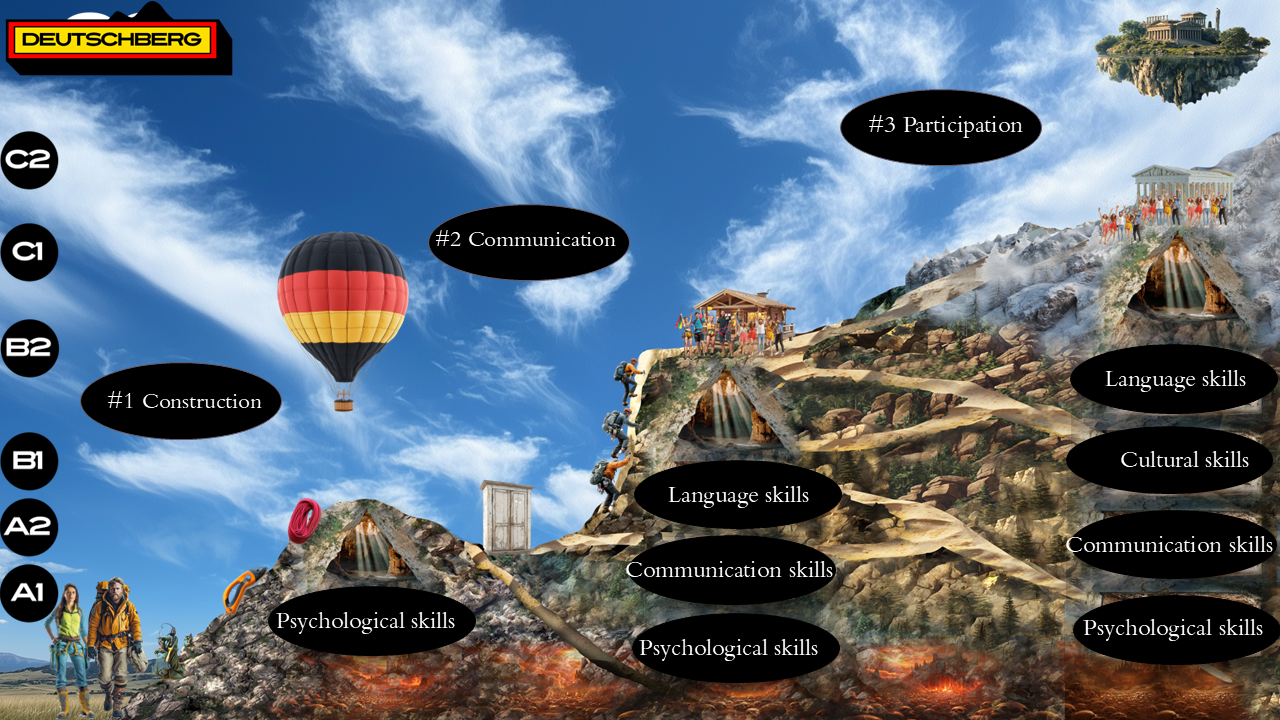
The Deutschberg – A metaphorical model of German-learning progression from A1 to C2, showing the three phases of the learning process and the competencies relevant to each phase (own illustration)
References
DeKeyser, R. M. (2000). The robustness of critical period effects in second language acquisition. Studies in Second Language Acquisition, 22(4), 499–533.
Dörnyei, Z. (2009). The psychology of second language acquisition. Oxford University Press.
Erikson, E. H. (1968). Identity: Youth and crisis. Norton.
Fadjukoff, P., Pulkkinen, L., & Kokko, K. (2016). Identity formation in adulthood: A longitudinal study from age 27 to 50. Identity: An International Journal of Theory and Research, 16(1), 8–23.
Höfler, E., Kandlhofer, M., Ninaus, M., & Strasser, T. (2024). Künstliche Intelligenz im Bildungsbereich: Eine Verortung. In Bundesministerium für Bildung, Wissenschaft und Forschung (Ed.), Nationaler Bildungsbericht 2024 – Teil 3: Ausgewählte Entwicklungsfelder (pp. 425–464). BMBWF.
Krashen, S. D. (1982). Principles and practice in second language acquisition. Pergamon Press.
Lightbown, P. M., & Spada, N. (2021). How languages are learned (5th ed.). Oxford University Press.
Marian, V. (2023). The power of language: How the codes we use to think, speak, and live transform our minds. Dutton.
Mediendienst Integration. (2025). Ausländer und Migranten in Deutschland. https://mediendienst-integration.de/bevoelkerung/auslaender-und-migranten-in-deutschland/
Norton, B. (2013). Identity and language learning: Extending the conversation (2nd ed.). Multilingual Matters.
Oyserman, D. (2015). Pathways to success through identity-based motivation. Oxford University Press.
Pavlenko, A. (2006). Bilingual minds: Emotional experience, expression, and representation. Multilingual Matters.
Ryan, R. M., & Deci, E. L. (2017). Self-determination theory: Basic psychological needs in motivation, development, and wellness. Guilford Press.
Urlaub, P., & Dessein, E. (2022). Machine translation and foreign language education. Frontiers in Artificial Intelligence, 5, 936111.